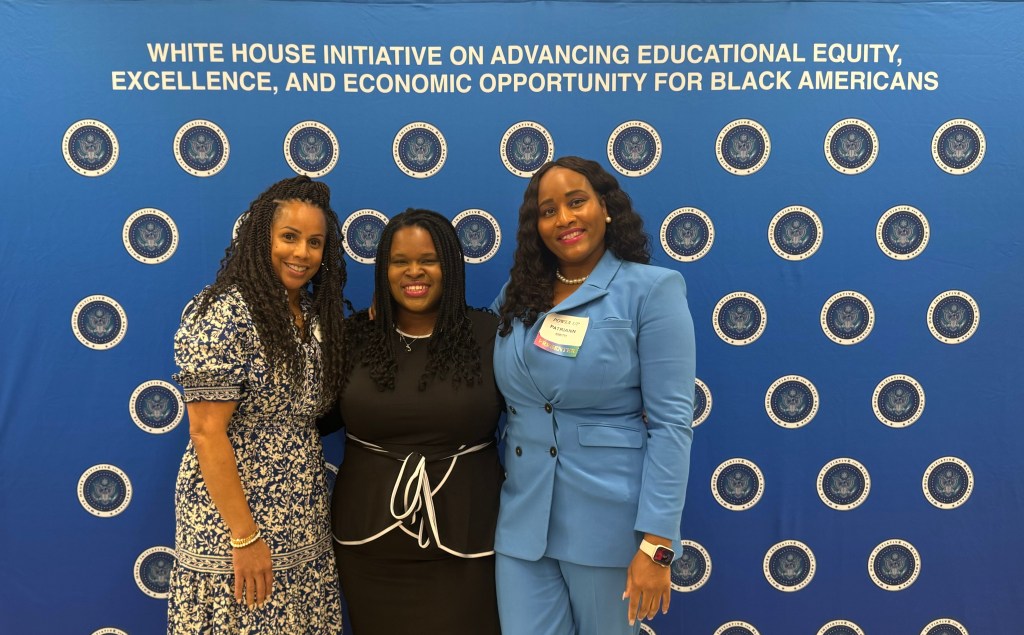
On June 12 & 13, 2024, the White House Initiative on Advancing Educational Equity, Excellence, and Economic Opportunity for Black Americans and Discovery Education, convened the Power Up summit in Chicago, IL under the leadership of Malcolm Kenyatta (Chair, Presidential Advisory Commission) & Monique S. Toussaint (MA, GCDF), Senior Advisor, White House Initiative on Advancing Educational Equity, Excellence, and Economic Opportunity for Black Americans, U.S. Department of Education.
![Dr. Patriann Smith serves as a Panelist on the White House Initiative on Advancing Educational Equity, Excellence, and Economic Opportunity for Black Americans' Raise the Bar Power Up Chicago [2024]](https://patriannsmith.com/wp-content/uploads/2024/06/img_0826-1-4076607220-e1719496926453.jpg)
As an invited panelist by Monique Toussaint to the “Global Pathways” segment of this initiative, Dr. Patriann Smith served alongside panel speakers, Siani Brown-Carr, Track and Field Student Athlete, Marquette University, Dr. Brandon Nichols, Senior Vice President for Academic Affairs, Olive-Harvey College, City Colleges of Chicago, Dr. Kourtney Ross, Assistant Dean of Students, Crown Family School of Social Work, Policy, and Practice, University of Chicago, Jacqueline Smalls, Senior Vice President, Corporate and Community Engagement, Transfr, and Jerome “JYD” Williams, Retired NBA Player and Chairman of JYD Project Inc.
Below are some of the ideas that informed Dr. Smith’s insights and responses to questions posed during the panel. These ideas represent support for a vision of educational equity, excellence, and economic opportunity for and by Black Americans, bolstered by a transnational ethos.
- Tell us about yourself and the work you are doing.
My name is Patriann Smith and I serve as Professor of literacy at the University of South Florida. As a Saint Lucian by birth who functioned as a former K-12 teacher in Saint Lucia and Trinidad and Toabgo, and as a scholar-mother-educator who has lived and worked in the United States for the past 15 years, my research is focused on race, language, and immigration with a particular emphasis on how these constructs work together to create new ways about teaching reading and literacy across K-12 and university classrooms.
I have concentrated specifically on Black Caribbean and African immigrants in my research with my latest books, sole-authored, co-authored, and co-edited, from Teachers College Press and Cambridge University Press — Affirming Black Students’ Literacies, Black Immigrant Literacies, Literacies of Migration, and Educating African Immigrant Youth. These books reveal how transnationalism and immigration work together to allow for transraciolinguistic justice in literacy teaching and learning.
My most recent projects have involved local research practice partnerships with elementary, middle, and high schools in Texas, research across Saint Lucia, Trinidad, Jamaica, and Barbados, as well as transnational research practice partnerships such as the USAID-funded $3.6 million transnational research practice partnership through which the University of South Florida partnered with the University of the West Indies Cave Hill to create structures for addressing educational concerns in mathematics, literacy, special education and other areas of need across the English speaking Caribbean. Through this partnership, I served as Co-Founder of the RISE Caribbean Educational Research Center which has now been launched at The UWI Cave Hill in Barbados.
![Dr. Patriann Smith with Monique Toussaint, Senior Advisor
White House Initiative on Advancing Educational Equity, Excellence, and Economic Opportunity for Black Americans and Co-Panelist Jacqueline Smalls at Raise the Bar's Power Up Chicago [2024]](https://patriannsmith.com/wp-content/uploads/2024/06/img_0824-1-4051223194-e1719497282719.jpg)
White House Initiative on Advancing Educational Equity, Excellence, and Economic Opportunity for Black Americans and Co-Panelist Jacqueline Smalls, Senior Vice President, Corporate and Community Engagement, Transfr, at Raise the Bar’s Power Up Chicago [2024]
I am currently bringing my expertise on race, language, and immigration to a group of scholars working on an NIH initiative to prevent suicide for Black youth, addressing one of the key statistics concerning the mortality rates of Black youth and how literacies and language function as a form of violence to Black peoples.
As Vice President-Elect of the premiere Literacy Research Association (LRA) in the US (2024-), I will embark late this fall on working with literacy leaders to continue advancing conversations about what it means to reflect equitable and global orientations to literacy. It is an honor and a pleasure to be here and I’m looking forward to this conversation.
- What culturally competent best practices and/or models have you found to be effective for recruiting and retaining Black students in the postsecondary education space?
I’d like to speak about retention of Black students and specfically Black immigrant students in the postsecondary space with a focus on three frameworks: (1). The CARE framework; (2). A Transraciolinguistic Approach; and (3). The framework for Black Immigrant Literacies.
First, in our recently co-authored book, I worked with distinguished professors and former presidents of the Literacy Research Association, Drs Arlette Willis and Gwendolyn McMillon to outline the CARE framework as a model for working with all Black students and as critical for recruiting Black students in the postsecondary education space.
The CARE framework drawn from the extant and comprehensive body of research on Black US women literacy teachers reflects the intergenerational idea among Black teachers that an emphasis is needed on the whole child through the notion of C.A. R. E. The acronym stands for: (a) Centered on Black Students; (b) Aware of anti-Blackness; (c) advances Racial Equity/Justice, and (d) outlines specific Expectations of University Personnel.
Second, in my new books, “Black Immigrant Literacies: Intersections of Race, Language, and Culture in the Classroom” and “Literacies of Migration: Translanguaging Imaginaries of Innocence” I focus on six youth/young adults who were 19 years old operating as newly admitted college students. The Black students from Jamaica and the Bahamas, often referred to as “international” by their universities were also considered “immigrants”. As immigrants or international students, I learned while working as the advisor of their Caribbean Student Association that they were grappling with the ways that they were positioned based on their race, while also being judged for how they used language even as they coped with xenophobia.
For such immigrant postsecondary students racialized as Black in the US who use language in ways that are different from what is expected, one of the elements that I focus on in my book, is “A Transraciolinguistic Approach.” This approach allows university professors, administrators, staff, and other students to recognize how millions of Black students bring what I refer to in my book as the 3 M’s or can develop and hone these 3 M’s — the three M’s are metalinguistic understanding, metacultural understanding, and metaracial understanding.
![Dr. Patriann Smith with Monique Toussaint, Senior Advisor
White House Initiative on Advancing Educational Equity, Excellence, and Economic Opportunity for Black Americans at Raise the Bar's Power Up Chicago [2024]](https://patriannsmith.com/wp-content/uploads/2024/06/img_0829-1.jpg?w=768)
Metalinguistic understanding means that every time a Black student is functioning in a classroom or public sphere, many are often, if not always: (a) thinking about how they are thinking about their language (metalinguistic), (b) thinking about how they are thinking about their race (metaracial), and (c) thinking about how they are thinking about their culture (metacultural). Typically, they are doing more than one of these at the same time.
Universities disregard these assets in many instances as they tend to operate based on deficit notions of Black students. It is therefore often the case that they do not see these tremendous assets that Black students possess or know how to enable those who are immigrants to develop the metaracial and metacultural assets that they need to function as newcomers to the US space. In turn, universities miss opportunities highlighted in a transraciolinguistic approach for building bridges between Black immigrant students and their Black American peers as well as Black immigrant students and their white peers.
Third, just like A Transraciolinguistic Approach can help retain Black students at the postsecondary level, Black immigrant students, more specifically, who are largely understudied and misunderstood in US higher education, can be retained by paying close attention to how their race, languages (i.e., specifically Englishes), and culture intersect.
The Black Immigrant Literacies framework that I have proposed in my book specifies five tiers for enabling the Black immigrant young adult to see the world through US eyes while also legitimizing the transnational view of the world that these students bring. Specifically, the framework presents five tiers, helping Black immigrant students to understand the myth of the model minority, enabling them to participate in the shared struggle for justice with Black Americans, guiding them to recognize the 3 M’s they possess in a transraciolinguistic approach, enabling them to see race across their local and global worlds, and facilitating their holistic literacies beyond just academic measures.
Through the use of these frameworks, Black immigrant young adults can be better able to cope with the various intersectional pressures they face at the post-secondary level and also focus on leading flourishing lives. At the same time, universities have opportunities to better serve the Black immigrant populations that are increasingly part of their faculty, administration, and staff.
- What are some of the challenges facing Black students beyond high school?
I mentioned these challenges in part earlier but want to focus specifically on the literacies undergirding schooling and how this positions Black students to function often on the peripheries of universities and classrooms. As a literacy expert, one of the areas that we often hear highlighted in the research is the idea of how English comprehension, vocabulary, fluency, phonics, etc. have such important roles across all subject areas in determining if and how students perform. This occurs before they get to college but it becomes even more critical when they embark on their postsecondary studies.
I saw this with the Black Caribbean youth with whom I worked and with a daughter in college, I see how the system can become daunting if these literacies that are privileged by institutions are the only ones expected in classrooms. And by this I mean, universities tend to operate based on the “white gaze” (see Toni Morrison) and on what scholars have discussed as the “white listening subject” (see Jonathan Rosa & Nelson Flores) to determine if and how Black students’ language will be accepted but also if and how their bodies (must) belong in predominantly white spaces. Their language use then becomes an indicator of how well their racialized bodies might fit into these spaces predicated on norms for Whiteness, creating challenges for students to feel a sense that all of their literacies belong so they can flourish.
![Dr. Patriann Smith with Dr John Armand at the
White House Initiative on Advancing Educational Equity, Excellence, and Economic Opportunity for Black Americans Raise the Bar's Power Up Chicago [2024]](https://patriannsmith.com/wp-content/uploads/2024/06/img_0834.jpg?w=768)
White House Initiative on Advancing Educational Equity, Excellence, and Economic Opportunity for Black Americans Raise the Bar’s Power Up Chicago [2024]
Many Black students who identify as African American might use their African American Language outside of these spaces in ways that reflect their full personhoods but feel incapable of thinking and being creative, and innovative, to present solutions in spaces where norms of Whiteness govern how they should present their bodies or sound in classrooms.
Other Black students who identify as international or as immigrant might use their Caribbean Black Englishes outside of these spaces but feel like they are illegitimate if they sound or act ‘too Caribbean‘ when they speak or if they appear to seem ‘too white’, despite being racialized as Black.
For all Black students then, the intersections of race, language, and nationality, ethnicity or culture, become critical.
We know too little about how these intersections work with the traditional English literacy rules and norms that they are expected to use across all subject areas in university spaces. In fact, we have neglected a pursuit of understanding how Black Englishes function broadly as a basis for undergirding what universities and schools do with literacy practice to legitimize certain types of students over others. Studies of how university professors, staff, and white students engage with Black students’ Englishes and literacies across US schools, universities and beyond are long overdue given that (Englished) literacy is the ONE COMMON DENOMINATOR undergirding whether any student will be deemed a failure or success in society.
- How can postsecondary institutions integrate DEI programs and practices to support Black students? How can organizations that support workforce development do the same?
- How does diverse leadership or the lack thereof affect the development of Black students as global citizens in postsecondary spaces?
The idea of diverse leadership in the development of Black students as global citizens is quite a compelling one. I alluded to this in my 2016 article titled “A Distinctly American Opportunity: Exploring Non-Standardized English(es) in Literacy Policy and Practice” and returned to the idea in the 2020 article, “How does a Black Person Speak English: Beyond American Language Norms” as well as in my book “Black Immigrant Literacies.
In the absence of diverse leadership, there is a critical gap in the capacity of leaders to recognize that the young adult of today’s postsecondary classroom functions based on what I describe as an increasingly inherent “transnational nativity”. As transnational natives, unlike the young adult of yesteryear, these youth no longer function based just on a worldview that is largely limited to its local context. Rather, and in fact, the transnational native, regardless of often not having immigrated, by default, I argue, is seeing the world through local as well as global eyes.
![Dr. Patriann Smith with Co-Panelist, Jacqueline Smalls at The
White House Initiative on Advancing Educational Equity, Excellence, and Economic Opportunity for Black Americans Raise the Bar's Power Up Chicago [2024]](https://patriannsmith.com/wp-content/uploads/2024/06/img_5715.jpg?w=1024)
White House Initiative on Advancing Educational Equity, Excellence, and Economic Opportunity for Black Americans Raise the Bar’s Power Up Chicago [2024]
Well what does this mean? Without a diverse leadership which understands or uses this transnational native skillset, what you really have is a group of leaders who often (not always) mean well but who, with generational blinders on, may tend to rely on a paradigm of the past to attempt to govern what are clearly, completely and distinctly different dispensations of presents and futures.
So, I would argue that not only do we need diverse leadership — many leaders are considered ‘diverse’ (we know now that no one is inherently ‘diverse’) yet lack the capacity to see the world through global eyes — but we also need leadership that is capable, by default, of operating using the premises of transnational mechanisms such as a transraciolingusitic approach. We need leaders who can tap into such resources like the 3 M’s of Black students and integrate these into institutional structures to bridge local and global realities while also creating relational pathways for students to engage across races, languages, and creeds.
- In recognition of both Caribbean Heritage and Pride Months, what can organizations and institutions do to create environments that are inclusive, culturally responsive, and support all Black students? Dr. Smith, particularly for immigrant students, how do help them find a sense of identity and a community of support?
I may have already touched on some of these ideas but I want to emphasize further the need for organizations to engage intentionally with shifting institutional norms that relate to the intersections of race, language, and culture. Often we think of how Black students are affected whether as a whole or in part, but institutional norms beyond the individual Black child are designed to also hold and to keep power.
In particular, I have a vision for engaging units such as the Multicultural Offices, Offices of Belonging, Inclusivity, DEI, Black Faculty and Staff Associations, International Student Services and organizations etc. at all universities within and beyond the US, to intentionally enable university professors to acknowledge, develop, and leverage mechanisms that my colleagues and I have worked on such as CARE, A Transraciolinguistic Approach, the Black Immigrant Literacies Framework, the 3 M’s, etc.
Beyond these, there are admittedly numerous other pedagogies, frameworks, and approaches proposed by Black and brown scholars as well as other scholars of Color such as “Culturally Relevant Teaching” by Dr Gloria Ladson-Billings, “Culturally Sustaining Pedagogies” by Drs H. Samy Alim & Django Paris, “Linguistic Justice” as advanced by Dr April Baker Bell, “Historically Responsive Literacy Teaching” by Dr Gholdy Muhammad, developed to serve Black and all students across school and university classrooms.
Part of what needs to happen, as I explain in my book, is shifting the classroom spaces as well as other institutional pockets of universities from operating based on a monolingual, monocultural, and monoracial norm. And how do you do this? You do this by changing the people, changing the policies undergirding practice, and also, changing the practice itself.
Inspired by the research of Drs H. Samy Alim, Arnetha Ball, John Rickford, Nelson Flores, & Jonathan Rosa on raciolinguistics, I see this focus on shifting language norms as critical to changing what we view as students’ legitimate literacies. This means engaging in a crafting of university policies and legislation that make clear how university systems are designed often to promote: (a) one language as well as one type of English above all Englishes— Mainstream (American) English; (b) the ways of being, doing and living together with of one race — peoples racialized as White — over that of other races; and (c) the ways of being and doing of one culture — the culture of people who are considered native to the US or to a certain prescribed acceptable form of Eurocentricity as legitimate — over other cultures.
This shift requires university Boards of Trustees, Presidents, Deans, Associate Deans, Department Chairs to commit to enacting university legislation in the face of the bold and ongoing backlash on Critical Race Theory such as what we face in the state of Florida via subtle mechanisms such as an unscientific “Science of Reading” and more overt forms of delegimization of Black and other people such as book bans. It requires Policy-Makers, Principals, District Leaders and Administrators to take up the mantle of the ‘multi’ in a world where transnational nativity has become our new normal. A clear and unapologetic stance is needed by universities and schools designed to serve the public good in declaring multilingualism, multiracialism, and multiculturalism as the new norms for operating in the current dispensation.
As USDOE Secretary Cardona has declared bilingualism as a superpower, so must universities declare in this moment the impending need to recognize and operate with multilingualism as a new normal, resisting the urge to succumb to a complacency surrounding certain privileged Englishes that places our democracy as well as current and future generations of children at risk. So how do we shift the norms in university to facilitate notions such as “Translanguaging with Englishes” that allow students to be their full selves?
It requires universities to engage intentionally with sanctioning the use of codification in speaking, writing, and semiotics more broadly, that commits to allowing students to draw from what I describe using my Saint Lucian French Creole in my new Cambridge University Press book, “Literacies of Migration” as their “innosans jan nwè” and thus, “linguistic innocence.” No longer do we need to succumb to dichotomies or “proper” vs “non-proper” Englishes in this conversation — we know now that quantum realities demand an extending beyond. Instead, there is a need to allow for full revelations of students in their presentations of self to the world through the languaging and broader semiotics that they bring.
Universities, schools, organizations, operate in this moment at a critical juncture in earth’s history where we are urgently invited to take action in an emerging era of AI — one that legitimizes the capacity of millions of children and youth (Black, brown, white or otherwise) to function sans “White Gaze.” This addition of the word “sans” to the concept of “White Gaze” conceptualized by Toni Morrison, and discussed in my book based on revelations from the literacies and lives of Black immigrants operating completely oblivious to the white gaze, is especially critical given the movements designed to sustain anti-Blackness within and beyond university spaces and to glorify what so many have previously acknowledged as a horrific slave-based US foundation.
![Dr. Patriann Smith with the lovely Joyce at the
White House Initiative on Advancing Educational Equity, Excellence, and Economic Opportunity for Black Americans Raise the Bar's Power Up Chicago [2024]](https://patriannsmith.com/wp-content/uploads/2024/06/img_0832.jpg?w=768)
White House Initiative on Advancing Educational Equity, Excellence, and Economic Opportunity for Black Americans Raise the Bar’s Power Up Chicago [2024]
For immigrant students, I envision working with all International Student Services offices on discussions of the intersections of race, language, and immigration for Black immigrants and millions of other racialized populations in the postsecondary world. Leveraging the tenets of a transraciolinguistic approach as well as the Black Immigrant literacies framework is critical to enabling students to understand how to cope with the intersectional impacts of race, language, and immigration and how these function to either enable or deter them from using their literacies to flourish and to thrive.
- Based on your expertise and/or research, what are the most critical factors influencing the college and career pathways of Black students, and how can collaborative efforts between higher education, philanthropy, state departments of education, and K-12 college access offices address these factors to ensure equitable outcomes?
I would again say it is a lack of attention to the intersectional effects of race and language for Black Americans and for race and language for Black immigrants or international students, specifically with regards to how this is used through Englishes and English literacies to determine the futures of millions of young adults by university professors, administrators, and staff on a daily basis. Until such time as the recently focused approach on bilingualism as an intended norm by Secretary Cardona and his team, guidelines have continued to operate that sustain monolingual, monocultural, and monoracial ideologies alive and codified in all subject areas across classrooms and universities. Already, we are beginning to see streamlined efforts that can ultimately and hopefully, eventually require universities to federally shift their requirement of students to strip themselves of who they are even in the face of a backlash against Critical Race Theory. Thus, the work that has been done at the individual level and institutionally in part is continuing to be advanced, and as the Black Majority world continues to be awakened, so too will our universities.
- How can federal, state, local, community, and faith organizations connect Black students with resources to support their academic achievement and/or professional development after high school?
In my book, Black immigrant literacies, I describe the specific mechanisms through which these organizations must serve as a grounding space for youth. Podcasts, community events, spaces for helping youth lead purposeful lives, and opportunities to engage youth with the transnational nativity that they bring to spaces, are all key.
- What role can families and community members play in supporting Black students?
In my research, I allude to mechanisms such as “Parent of Color Stories” co-designed with esteemed Michigan State University literacy professor Dr Patricia Edwards to recognize the plethora of unacknowledged parent realities that are missing from how we design educational solutions at large. Dr Edwards and I argue that much of the way in which universities support Black students does not take into account the stories of parents on the margins — Black, immigrant, Latinx, etc. In order to recognize that parents sometimes have blindspots, there must be opportunities for them to get together to talk about, write, and harness the insights from their stories using the 3 M’s.
- How can organizations provide equitable access to resources for Black students in both rural and urban communities?
- Are there any success stories, best practices, and/or resources that you want to share?
In the southwestern university where I worked and partnered with immigrant students as well as with a school district to support literacy and overall well-being, I recognized so importantly, the value of partnerships across scholarly, community, and university or school settings. I have published in numerous articles the insights that we gained from learning about our blindspots regarding how to serve Black students through these partnerships. The key takeaway is that we can have lots of cultural responsiveness but no change of heart leading to the kind of backlash against humanity that we are seeing occurring today. The research and our current US context tells us that we need above all else, to cultivate critical multilingual awareness, critical multicultural awareness, and critical multiracial awareness that stems first from an embodiment of values and character steeped in recognition of the God-given potential of all Black and brown students and peoples.
Clearly, decades of research, strategies, resources, and initiatives reveal that nothing but a commitment of our peoples and institutions to a shared and just humanity can redeem us. Already, we are seeing emerging generations dedicated to this ethos — Generation Z, Generation Alpha — many of whom have come into the world to usher in the justice that so many of us have repeatedly withheld.
Ultimately then, the wheels of justice, though seemingly churning rather slowly, portend what will eventually be our ultimate decision, willingly or not, to abide by a duty of CARE to each Black child emanating from the space of a quantum consciousness stirred to morally and spiritually responsible advocacy.
![Dr. Patriann Smith serves as a Panelist on the White House Initiative on Advancing Educational Equity, Excellence, and Economic Opportunity for Black Americans' Raise the Bar Power Up Chicago [2024]](https://patriannsmith.com/wp-content/uploads/2024/06/img_0826-2.jpg?w=768)
 Patriann Smith, Ph.D.
Leave a comment