

Literacies of Migration: Translanguaging Imaginaries of Innocence
Drawing on the lived experiences of high school-aged young Black immigrants, this book paints imaginaries of translanguaging and transsemiotizing, leveraged transnationally by teenagers across the Caribbean and the United States.
The Black Caribbean youth reflect a full range of literacy practices – six distinct holistic literacies – identified as a basis for flourishing. These literacies encapsulate numerous examples of how the youth are racialized transgeographically, based on their translanguaging and transsemiotizing with Englishes, both institutionally and individually.
In turn, the book advances a heuristic of semiolingual innocence containing eight elements, informed by the Caribbean youth’s holistic literacies. Through the eight elements presented — flourishing, purpose, comfort, expansion, paradox, originality, interdependence, and imagination – stakeholders and systems will be positioned to better understand and address the urgent needs of these youth.
Ultimately, the heuristic supports a reinscribing of semiolingual innocence for Black Caribbean immigrant and transnational youth, as well as for all youth.

- Identifies six holistic literacies demonstrated by Black Caribbean immigrant youth for flourishing and reflects how the youth use these literacies based on translanguaging and transsemiotizing.
- Provides numerous examples of specific ways in which the languaging (i.e., Englishes) and semiotics of Black Caribbean youth are racialized transgeographically, as they engage in translanguaging and transsemiotizing, across the Caribbean and the United States.
- Presents a heuristic of semiolingual innocence containing eight elements based on the holistic literacies identified in the lived experiences of Black Caribbean immigrant youth.
- Decenters the tendency to focus on success based on achievement for Black immigrants which positions this population as a model minority and provides a more complete portrait of what a Black Caribbean immigrant youth’s literacies might entail.
- Functions as a compelling basis for advancing the notion of translanguaging and transsemiotizing with Englishes for millions of students across the world who use certain Englishes that are often racialized and/or positioned as inferior in classrooms.
- The eight elements presented in the heuristic of semiolingual innocence — flourishing, purpose, comfort, expansion, paradox, originality, interdependence, and imagination — are critical for addressing the post-COVID-19 global mental health pandemic currently assailing all youth, and specifically Black youth and youth of Color whose deep desire to flourish based on purpose remains starkly at odds with an insistence on returning to the normal of schools steeped in traditional notions of success.
About the Cover
Join me, beautiful people, in welcoming, at long last, this gem of a cover for “Literacies of Migration: Translanguaging Imaginaries of Innocence” — my latest book with Cambridge University Press, finally ready to say ‘hello world.’ This image for my new book which I fell in love with a few years ago but debated for so long, was captivating in part because the instantiation of this beautiful translucent butterfly represents fully the metamorphosis of the Caribbean youth racialized as Black as they cross almost impossible boundaries while at the same time, creating effervescent flourishing imaginaries.
Depending on the perspective, the butterfly seems at times to be departing, flying away, but at other instances, if you look closely, it appears to be approaching, drawing near, symbolizing the notion of “both-and” as well as the constant positioning and re-positioning that Black youth occupy depending on who is doing the seeing, the anticipating, the expecting surrounding entanglements of their languaging, semiotizing, race, and personhoods.
As a symbol of transcendence, metamorphosis, and transformation encapsulated in grace and representing resurrection, endurance, and hope throughout time, the emergent butterfly here signals the transformative process shrouded in the interactions of the institutional and individual, indelibly informing but also failing to obstruct the vibrant beating wings of Black innocence.
In the lighthearted and graceful soaring of this constantly repositioned butterfly, representative of youth’s migration and transnationalism, whether symbolic or literal, we see the fluid and dynamic literate processes born of their translanguaging and transsemiotizing always at play, constantly racialized, but also, iteratively crystallized, almost always incredulously, capable of being offered unapologetically to the world sans attention to white gaze.
Representing spirit, rejuvenation, and life, we see the beautiful droplets of water, collective imaginaries that youth continue to create, caressing the transient beauty of translanguaging and transsemiotizing that encapsulates Black life, purifying the hurt, restoring the inherent semiolingual innocence of Black youth, somehow almost imperceptibly, before our very eyes.
In the soft hues of an almost blue, yellow, Black, and white — these vibrantly intertwined colors of the Saint Lucian flag— we are captivated by the perpetual yet steady Caribbean dance of the Black transnational hearts of youth that sing, yearning to beat redemptively in sync with the quantum possiblities that undergird a shared humanity — emboldened through the infinite stream of unsilenced Caribbeanness that is a literacies of migration.
Grateful for this captivating visual and the chance to unveil this beauty of a cover to the world.
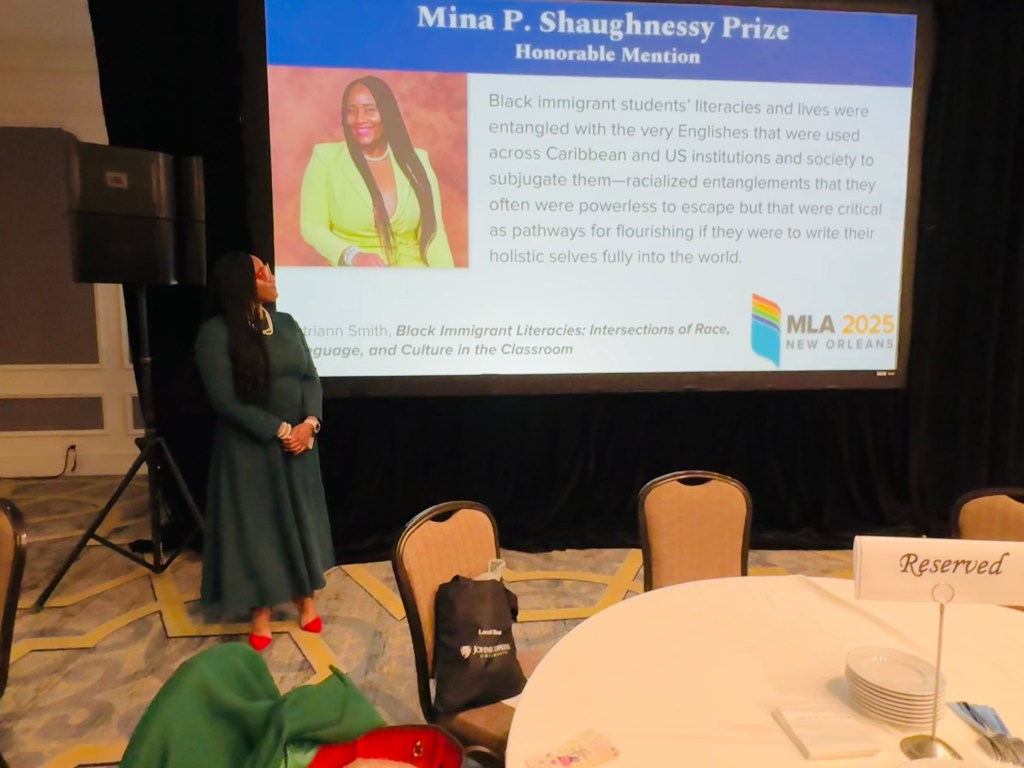
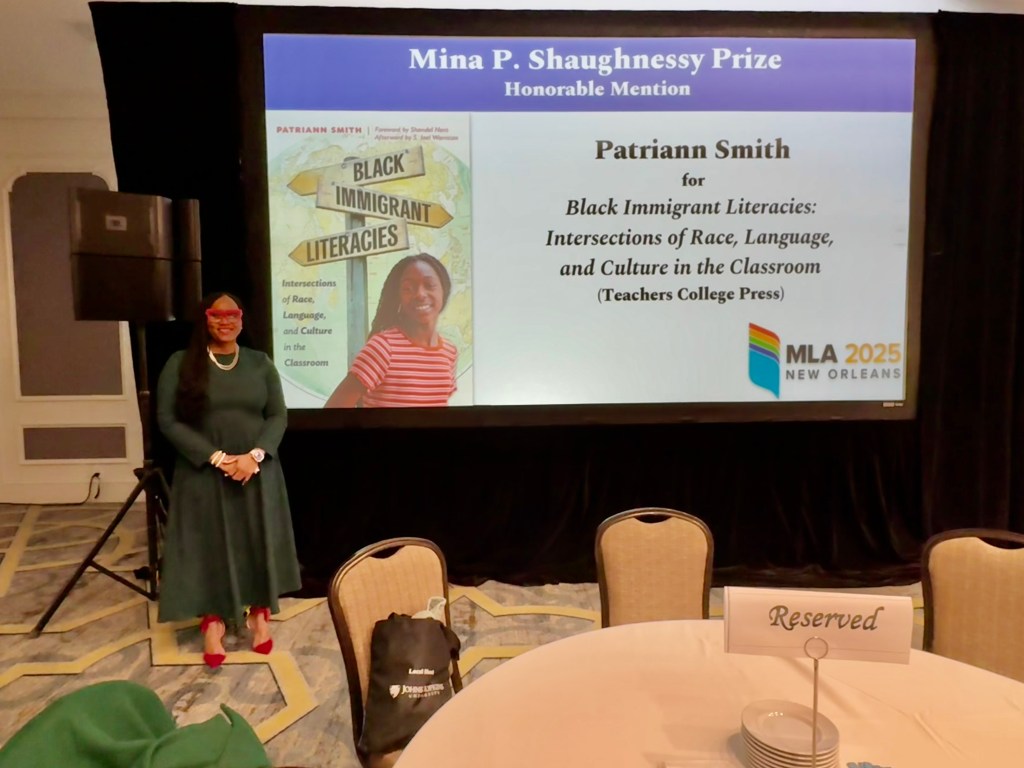
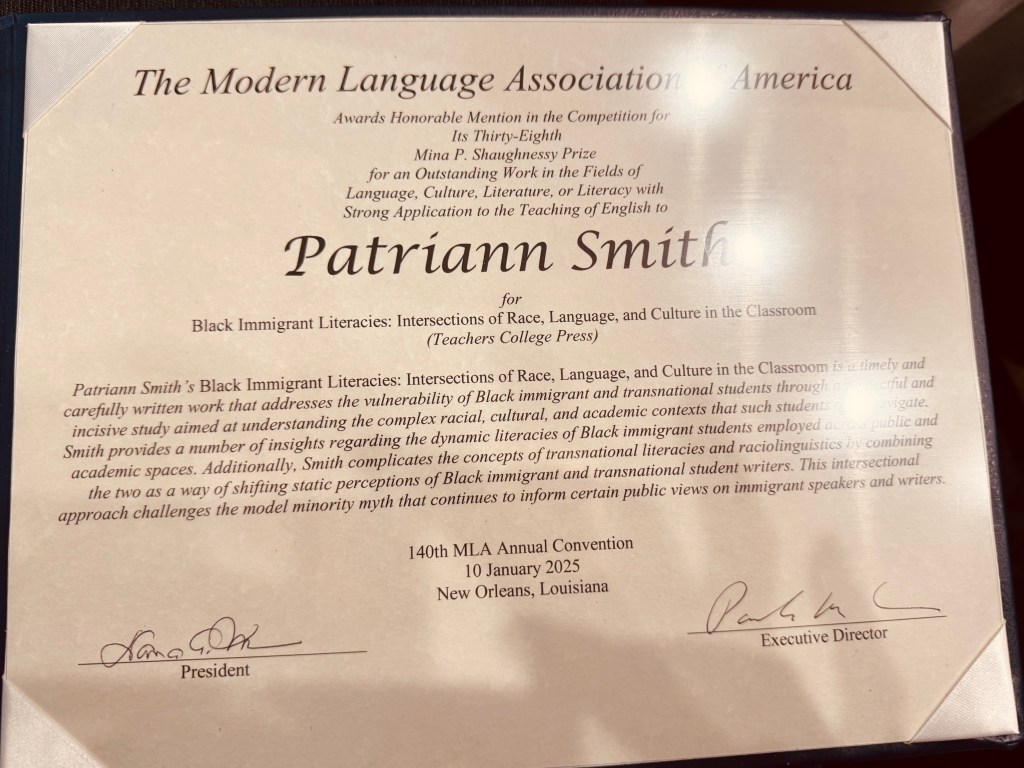
Black Immigrant Literacies: Intersections of Race, Language, and Culture in the Classroom
Learn how to center, affirm, and develop Black immigrant literacies in ways that allow all youth to engage with and honor their literacies. This book presents a framework to revolutionize teaching in ways that draw on students’ assets for redesigning, rethinking, and reimagining literacy and the English Language Arts curriculum.
This novel framework has five mechanisms through which Black immigrant literacies and languaging can be better understood: the struggle for justice, the myth of the model minority, transraciolinguistics, the local-global, and holistic literacies.
Presenting authentic narratives of Afro-Caribbean youth, the author describes how teachers and educators can: (1) teach the Black literate immigrant; (2) use literacy and English language arts curriculum as a vehicle for instructing Black immigrant youth; (3) foster relations among Black immigrants and their peers through literacy; and (4) connect parents, schools, and communities.
The text includes lesson plans, instructional modules, and templates that range in their focus from K–12 to college.

- Details how teachers, curriculum, and instruction can benefit from understanding the experiences of Black immigrant students, and how that experience differs from other Black American students.
- Highlights authentic narratives that center the holistic voices of Afro-Caribbean immigrant youth from Jamaica and the Bahamas.
- Demonstrates how students grapple with racialization, becoming immigrants, and the responses of others to their use of Englishes in the United States.
- Offers research-based methods for teaching all students to draw on their metalinguistic, metacultural, and metaracial understandings in literacy and ELA classrooms.
- Presents concrete strategies for supporting Black immigrant populations in establishing and sustaining a sense of community across linguistic, cultural, and racial contexts.
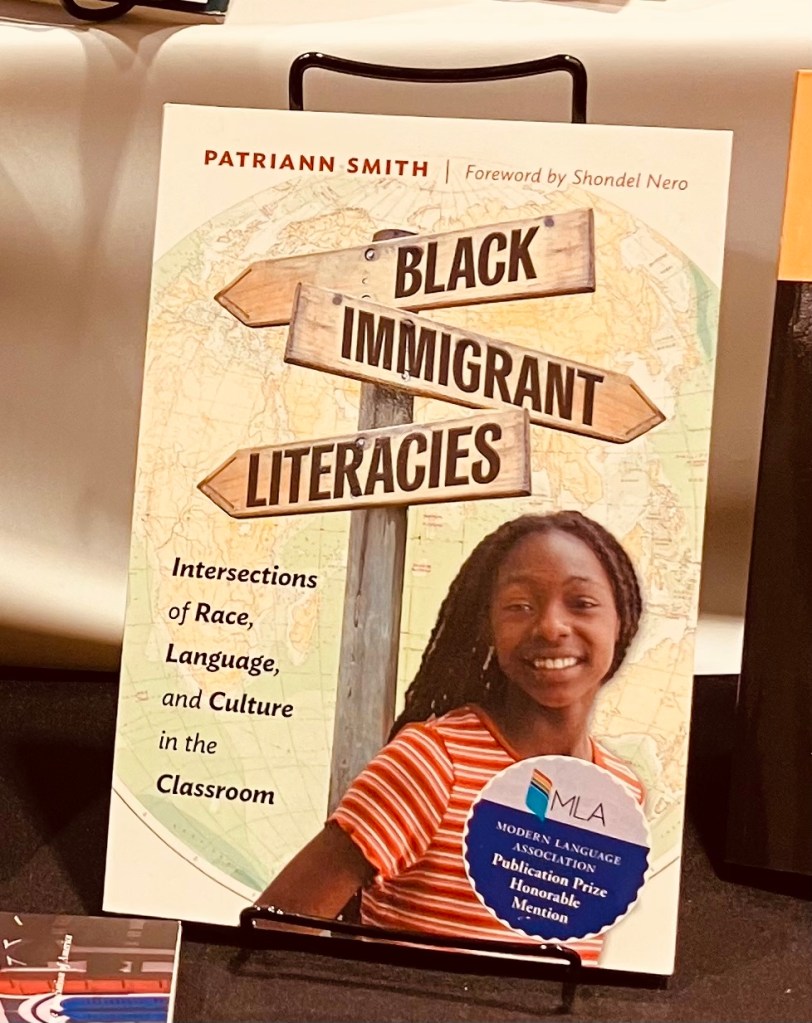
About the Cover
Thank you for joining me to celebrate this amazingly crafted book cover that represents the beautiful birth of my new book, “Black Immigrant Literacies: Intersections of Race, Language, and Culture in the Classroom”! Thank you also to the Teachers College Press cover designer who worked to impeccably paint this complex and symbolic portrait of Black beauty and joy against a backdrop of intersectionality informed by race, language, and immigration.
As a teacher in St. Lucia and Trinidad & Tobago in the Caribbean, a process that I describe in this video, one of the names that I quickly got to know was the name of Dr. Shondel Nero, Guyanese-born Professor of Language Education at New York University. In my evolution as a scholar for the past ten years, Dr. Nero, who has come to be known as a major voice for Black Caribbean Englishes and literacies in the United States and beyond for the past three decades, has become foundational to my crafting of an art of advocacy for the languaging and Englishes of Black immigrant and Caribbean youth.
Recently, I had the remarkable opportunity to meet Dr. Nero at the American Association of Applied Linguistics for the first time. What’s more, she’s just authored the most impeccable Foreword for my book.
I have dreamed since I was a little girl that I would study language and literacy as I have always loved books for their own sake. What I didn’t know is that my dreaming would take me on a path away from Caribbean shores to the US where my destiny would be intertwined with a deep sense of advocacy for the Black literacies of youth, children, adults, many of whom migrate, often just to survive.
For me, writing this book is cathartic, though merely a skimming of the surface of the intricacies that represent the Black immigrant life. I see this modest extension of celebrating beautiful and joyful Blackness as key to demonstrating how institutions and societies can reduce the burden that Blackness is made to become for the Black immigrant, and for Black peoples across the world. Grateful for “raciolinguistics” by Dr. H. Samy Alim and colleagues and “a raciolinguistic perspective” from the research of Drs. Nelson Flores and Jonathan Rosa that provided a foundation for this book.
As “my love note to Black immigrants across the world” this book, featuring the Jamaican, Chloe and the Bahamian, Ervin, explains the complexities of being Black, becoming immigrant and becoming a speaker whose Englishes become questioned. If you work with at least one Black immigrant child, youth, adult during the course of your daily life, this book is for you. Teachers, instructors, others, who work with Black immigrants can learn how their literacies function, disrupting normative notions of literacy in the United States.
Together, let us silence the invisibility of Black immigrant literacies in the United States and beyond. #race #language #immigration #Blackimigrantliteracies #education #teachers #literacy #Caribbean #Africa #BIMLIT2023
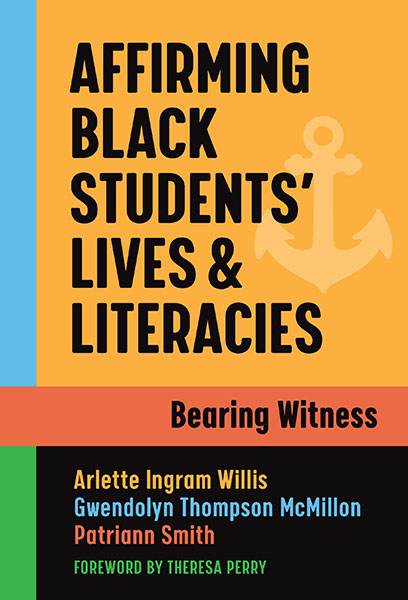
Affirming Black Students’ Lives and Literacies: Bearing Witness
Drawing on the authors’ experiences as Black parents, researchers, teachers, and teacher educators, this timely book presents a multipronged approach to affirming Black lives and literacies. The authors believe change is needed—not within Black children—but in the way they are perceived and educated, particularly in reading, writing, and critical thinking across grade levels.
To inform literacy teachers and school leaders, the authors provide a conceptual framework for reimagining literacy instruction based on Black philosophical and theoretical foundations, historical background, literacy research, and authentic experiences of Black students.
This important book includes counternarratives about the lives of Black learners, research conducted by Black scholars among Black students, examples of approaches to literacy with Black children that are making a difference, conversations among literacy researchers that move beyond academia; and a model for engaging all students in literacy. Affirming Black Students’ Lives and Literacies advocates for adopting a standard of care that will improve and support literacy achievement among today’s Black students by rejecting deficit presumptions and embracing the fullness of these students’ strengths.
- A counternarrative of Black literacy history, lives, and learners.
- Narrative examples of Black literacy scholarship, by Black scholars who embrace their faith-walk as an integral part of their holistic approach to literacy teaching and learning.
- Discussion questions to spur conversations among school administrators, parents/caregivers, politicians, reading researchers, teacher educators, and classroom teachers.
- An array of extant Black scholarship that should inform literacy praxis and research.
- A conceptual framework, CARE, that is applicable to all learners with a focus on Black literacy learners.
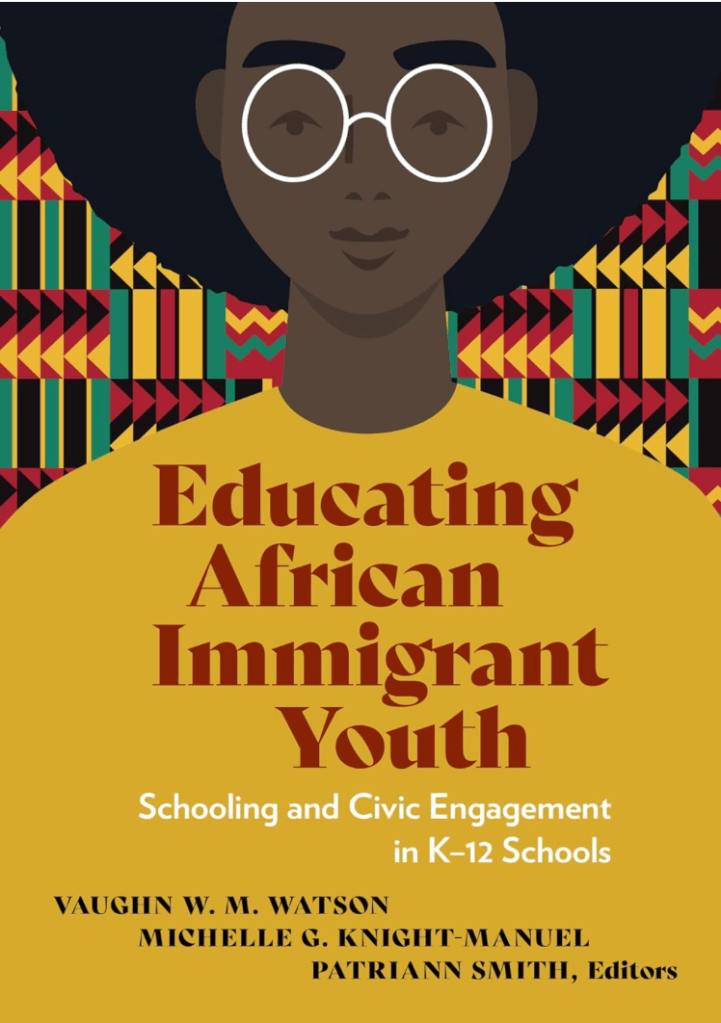
Educating African Immigrant Youth: Schooling and Civic Engagement in K–12 Schools
This book illuminates emerging perspectives and possibilities of the vibrant schooling and civic lives of Black African youth and communities in the United States, Canada, and globally. Chapters present key research on how to develop and enact teaching methodologies and research approaches that support Black African immigrant and refugee students.
The contributors illuminate contours of the Framework for Educating African Immigrant Youth, which focuses on four complementary approaches for teaching and learning: emboldening tellings of diaspora narratives; navigating the complex past, present, and future of teaching and learning; enacting social civic literacies to extend complex identities; and affirming and extending cultural, heritage, and embodied knowledges, languages, and practices.
The frameworks and practices will strengthen how educators address the interplay of identities presented by African, and by extension, Black immigrant populations. Disciplinary perspectives include literacy and language, social studies, civics, mathematics, and higher education; university and community partnerships; teacher education; global and comparative education; and after-school initiatives.
- A focus on honoring and affirming the range of youth and community’s diverse, embodied, social-civic literacies and lived experiences as part of their educational journey, reframing harmful narratives of immigrant youth, families, and Africa.
- Chapter authors that include Black African scholars, early-career, and senior scholars from a range of institutions, including in the United States and Canada.
- Chapters that draw on and extend a range of theoretical lenses grounded in African epistemologies and ontologies, as well as postcolonial and/or decolonizing approaches, culturally relevant and sustaining frameworks, language and literacy as a social practice, transnationalism, theater as social action, transformative and asset-based processes and practices, migration, and emotional capital, and more.
- A cross-disciplinary approach that addresses the scope and heterogeneity of African immigrant youth racialized as Black and their schooling, education, and civic engagement experiences. Implications are considered for teachers, teacher educators, and community educators.

 Patriann Smith, Ph.D.